Unifying fragmented customer identity into a compliant, marketable audience
Customer identity lived in four disconnected systems with 15K duplicate records and inconsistent consent tracking. Built a multi-tier verification framework, a product-to-Marketo integration with Engineering, and a GDPR-compliant opt-in program — without re-architecting the global MAP environment.
Architect and delivery owner, working as liaison across Marketing, Engineering, Legal, and Privacy.
The problem
Roughly 15,000 duplicate records and inconsistent consent tracking meant no source of truth for who a customer was or whether they could be contacted. Retention and growth programs had no compliant audience to run against.
Context
Marketing could not reliably identify, target, or engage post-sales customers. Identity was split across the product network, customer success tools, CRM, and the marketing automation platform, and Marketo's workspace and partition structure made a single accurate customer audience impractical to assemble.
Constraints and complexity
A partition overhaul was off the table — too much risk to a global instance. The solution had to work within the existing Marketo architecture and ship without disrupting worldwide operations. Delivered in two months.
Illustrative diagram
- 01Identity split across product, CS, CRM, and MAP
- 02~15K duplicate customer records
- 03Consent tracked inconsistently
- 04No compliant customer audience
- 01Multi-tier verified customer identity
- 02Partition-aware dedupe at ingestion
- 03Centralized, GDPR-compliant consent
- 0480% of the customer base addressable
What I did
How I approached it
- 01Verification, not deduplicationModeled customer identity as a multi-tier verification problem, which is a different problem with a different fix.
- 02Ranked signals by reliabilityOperational records, then product activity, then self-identification, then manual exception workflows.
- 03Partition-aware routingSo identity conflicts resolved at ingestion instead of requiring structural change to a global instance.
- 04Consent as a targeting enablerNot only a compliance obligation.
What I built
Supporting materials
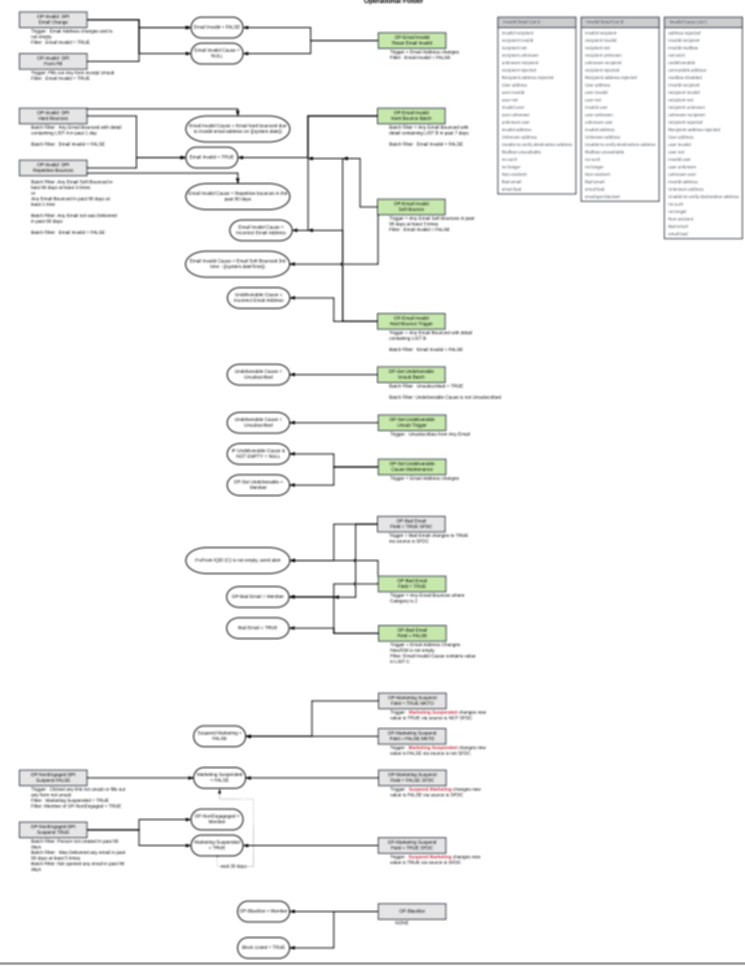
Diagrams and figures are representative. Proprietary architecture, internal system names, and confidential customer details are omitted or generalized.